Sweets for the nose in November

The nose doesn’t have much going for it in the month of November. That’s why we treasure any little bit of sniff going our way. The smell of fallen leaves is always heady to me, especially sugar maple leaves (Acer saccharum). Then there’s the lowly little annual (in my climate) edging plant aptly called sweet […]

Continue Reading

Such diversity in two short city blocks

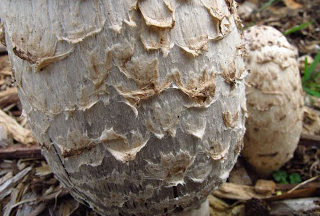
Shaggy mane fungus, Coprinus comatus Keep your eyes open, and Toronto’s diversity is all around you. All it took was a walk to the Toronto Public Library, just two blocks away. Three different species of fungi hailed me as I passed with my camera – and I’m sure that many more were camera shy. I’m […]

Continue Reading

Be a friend to Anemones

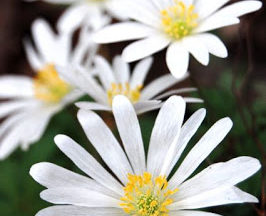
Anemone blanda ‘White Splendor’ Where would gardeners be without the gigantic Ranunculaceae or buttercup family? Well, we’d be without perennials such as Clematis, delphiniums and hellebores, without annuals such as columbines (Aquilegia) and love-in-a-mist (Nigella). And we’d be without anemones. And, without anemones, we’d miss out on one of the easiest early spring bloomers, Anemone […]

Continue Reading

Darned good ‘Bloodgood’ Japanese maple

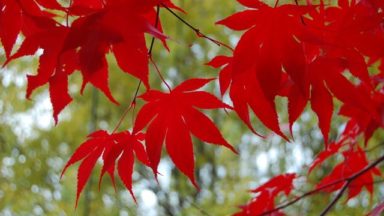
Acer palmatum ‘Bloodgood’ This is when the Japanese maple (Acer palmatum) ‘Bloodgood’ really starts living up to its name. Today, the sun was lighting up maples like this all over the city. ‘Bloodgood’ is one of the tougher ones – which it has to be in my dry shade garden. This is its second year, […]

Continue Reading

Two less-known bulbs for dry shade

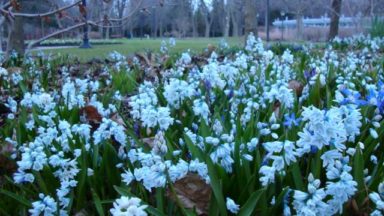
A carpet of Pushkinia and Chionodoxa at Rosetta McClain Gardens In his chapter on bulbs in Planting the Dry Shade Garden (a review of that will follow), Graham Rice mentions two that for me are tried and true, one that is on my wish list, and one big surprise. The charmer brightening the path above, […]

Continue Reading

Daisies in November?

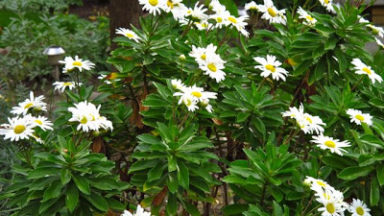
Nipponanthemum nipponicum in mid-October At first I thought this generous mound abloom in a neighbour’s garden was a shasta daisy. But, wait. Shasta daisies in October… and, now, November? And what’s with that distinctive foliage? The whorled form sort of reminded me of Pacific chrysanthemum. Could it be a mum? Well, I relish an ID […]

Continue Reading

Plant profile: Patrinia scabiosifolia

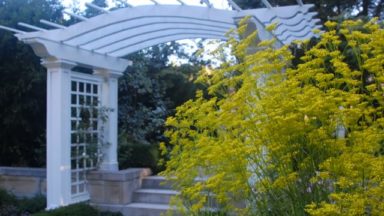
Patrinia scabiosifolia in the formal garden of Oldfields, Lilly House, on the grounds of Indianapolis Museum of Art There I was, wandering lonely as a cloud, floating on high o’er vales and hills (on the grounds of the Indy Museum of Art), when all at once, with apologies to Mr. Wordsworth, I saw a crowd […]

Continue Reading

Pear Trellis Rust isn’t pretty

The bright red foliage lesions and bumpy fruiting bodies of Pear Trellis Rust My sister-in-law was showing me the garden of their new home, including a number of fruit trees. Unfortunately, the foliage of the two pear trees are covered in red lesions, and the underside shows the clear signs that something is seriously amiss. […]

Continue Reading

Plant profile: Meet the peanut

Peanuts were in the news this morning*. This interested me, as I recently met peanuts in their growing state for the first time. The situation was an urban garden within spitting distance of downtown Indianapolis, which I’ll write about later. Of course most people know that peanuts are not nuts, but legumes, making them cousins […]

Continue Reading

Blooms Day in Toronto, August 2011

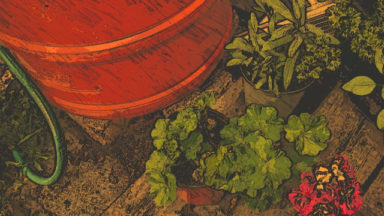
Still life, with rain barrel It isn’t often that we’d direct you from Toronto Gardens to our Facebook page. In fact, we’ve never done it before, and might never again. But for this Blooms Day, when nothing very much is happening in the garden, I wanted to have a bit of photographic fun with the […]

Continue Reading

Grow kiwifruit; yes, even in Toronto

The grapelike fruit of the hardy kiwi Actinidia arguta ‘Ananasnaya’ at UBC Botanical Garden, Vancouver If you aren’t a fan of the fuzzy skin on kiwifruit, you’re in luck. Not only are there smooth-skinned species, but they’re hardy in our climate. The one above was photographed in B.C. However, Actinidia arguta is available from at least […]

Continue Reading

Cedar apple rust on my serviceberry

The dark blue normal fruit of the serviceberry, along with one infected with Cedar apple rust It seems to be an OMG summer. Unusual things are happening after all the rain of spring 2011 – including a problem on my usually problem-free serviceberry (Amelanchier). OMG, what’s that? …was my reaction on seeing the intriguing spikes growing […]

Continue Reading